
Sea Buckthorn OEM vs. ODM: How to Choose the Right Manufacturing Partner for Your Brand?
With the rapid growth of the global health food market, the “superfruit” Sea Buckthorn, renowned for its rich Vitamin C, flavonoids, and rare Omega-7 (palmitoleic acid), is fast transitioning from a traditional nutritional remedy into a mainstream functional food, health beverage, and snack staple.
Whether you are an emerging health brand planning to launch pure sea buckthorn puree, or an established food enterprise expanding into functional sea buckthorn blended beverages, selecting the right manufacturing model is the crucial first step toward project success. When searching for supply chain partners, the two most common concepts you will encounter are OEM and ODM.
In this post, we will provide an in-depth analysis of the core differences between sea buckthorn OEM and ODM in the industry, taking into account the unique processing characteristics of sea buckthorn raw materials to help you identify the best manufacturing solution for your brand’s growth stage.
What is Sea Buckthorn Food OEM?
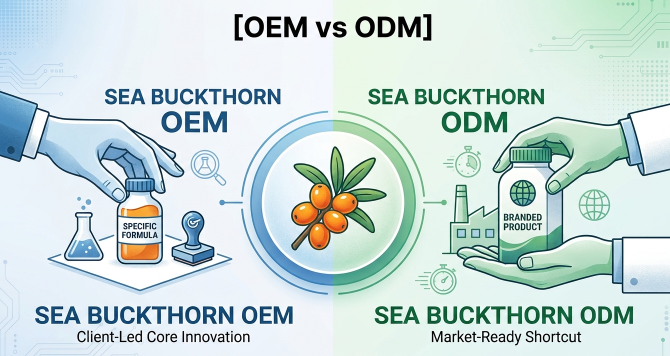
Sea Buckthorn Food OEM (Original Equipment Manufacturing) means a partnership agreement whereby the company that owns the brand or purchases products contracts another company to manufacture sea buckthorn food products in accordance with its specific needs.
In this case, the client will have a complete product design with formulas, product specifications, package designs or standards. The manufacturer will manufacture according to the requirements mutually agreed upon.
OEM helps the companies in outsourcing their manufacture process to specialized vendors when they already have developed their product ranges. Thus, this will allow them to utilize all the efforts on brand building and marketing.
Example: There is a foreign brand of drinks which is looking for a contractor who can take care of the mass production of their product of sea buckthorn juice. In this case, OEM is the ideal cooperation model.
What is Sea Buckthorn Food ODM?
Sea Buckthorn Food ODM (Original Design Manufacturing) refers to a model where the manufacturer not only provides production services but also actively participates in product development or design based on mutual agreements.
Unlike OEM, which primarily executes client-provided specifications, ODM offers extensive support to clients whose product development phase is not yet fully finalized.
Key Customization Services Offered by Sea Buckthorn Food ODM:
Product Concept & Solution Development
When a brand wants to introduce a new sea buckthorn juice, but the product is still at the stage of development of the concept, it may collaborate with a suitable producer who will be able to analyze the choice of ingredients and product types and possibilities of their production.
Formulation & Flavor Fine-Tuning
For products like sea buckthorn juices, buyers need to balance acidity, sweetness, ingredient ratios, and mouthfeel. Formulations are developed and adjusted by manufacturers equipped with in-house R&D capabilities.
Custom Packaging Solutions
Ingredients ratio, flavor and acid-sweet balance of such beverages as sea buckthorn juices should be taken into consideration while purchasing. Products’ formulations are created and altered by manufacturers that have R&D facilities.
Private Label Product Development
Depending on brand positioning and distribution channels, both sides may come to an agreement regarding serving size, materials for packaging, labels design, and outer packaging as well.
What Are the Key Differences Between OEM and ODM?
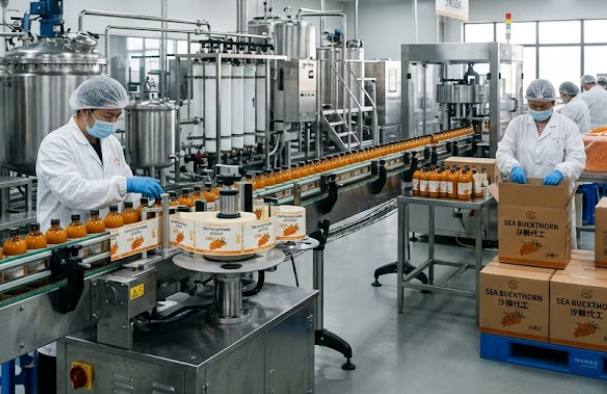
For companies looking to procure sea buckthorn food products, the primary difference between OEM and ODM lies in who leads the product development phase and the extent of the manufacturer’s involvement.
| Comparison Dimension | Sea Buckthorn Food OEM | Sea Buckthorn Food ODM |
| Product Concept | Buyer provides clear, fully defined requirements | Manufacturer participates in development based on scope |
| Formulation Needs | Produced strictly according to approved formula | Formula development and fine-tuning can be customized |
| Product Design | Buyer leads all product specifications | Manufacturer contributes to product format and design |
| Packaging Customization | Customized based on existing specifications | Jointly designed according to brand requirements |
| Ideal Clients | Brands with mature product solutions | Companies needing product R&D and design support |
| Focus of Partnership | Production capacity, quality control, supply stability | R&D capabilities, sample development, customization scope |
| Upstream Preparation | Finalized specs, formulations, and procurement criteria | Product concept, target market, and functional goals |
Technical Thresholds & Special Considerations in Sea Buckthorn Processing
Unlike other agricultural products, sea buckthorn is endowed with some special physical and nutritional features, making high requirements for its production equipment and technologies. In any case, when choosing OEM and ODM, you need to pay attention to the producer’s work in such spheres as:
Flavor & Acidity Balance
Wild sea buckthorn berries naturally contain high concentrations of organic acids (such as malic acid and oxalic acid), resulting in extreme natural tartness and an astringent taste.
OEM Consideration: Does your formulation retain active functional benefits while achieving palatability (e.g., through fruit juice blending or prebiotic fructooligosaccharides)? Can the factory precisely reproduce the sample’s taste profile on the production line?
ODM Consideration: Has the factory’s off-the-shelf sea buckthorn puree or juice formulation undergone sensory testing? Is the acid-to-sweetness ratio optimized for your target audience (e.g., young consumers vs. middle-aged wellness enthusiasts)?
Emulsification & Stability Control
Sea buckthorn pulp is rich in natural sea buckthorn fruit oil. When processed into purees or clear juice beverages, it is highly prone to oil separation, floating oil rings, or bottom sedimentation.
A qualified factory must utilize physical stability technologies such as High-Pressure Homogenization and microencapsulation to maintain a smooth texture and uniform suspension without overusing artificial gums/stabilizers.
Nutrient Retention & Thermal Sterilization
Vitamin C and total sea buckthorn flavonoids are extremely heat-sensitive. Traditional high-temperature, long-time sterilization destroys active nutrients and imparts a “cooked” off-flavor, spoiling the fresh berry aroma.
Check whether the manufacturer utilizes UHT (Ultra-High Temperature) Instant Sterilization or pasteurization paired with aseptic/cold filling equipment. This is essential for preserving the vibrant yellow color, fresh taste, and nutritional potency.
Should Your Brand Choose Sea Buckthorn OEM or ODM?
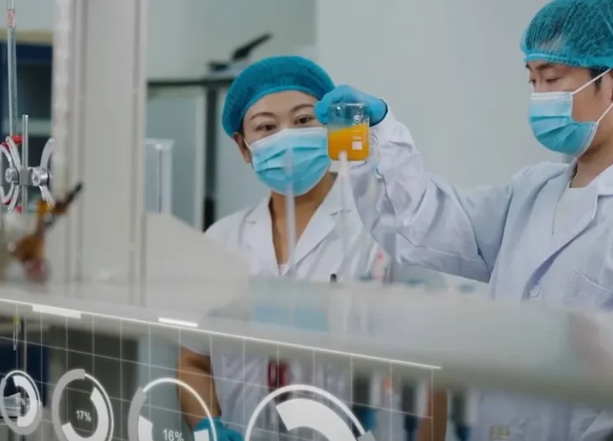
The choice between OEM and ODM depends primarily on your current product development stage, internal resources, and procurement goals.
Scenario A: Choose OEM to Build an Exclusive Global Brand
OEM is the optimal strategic choice if your goal is to build long-term brand equity, technical barriers, and a premium market positioning.
You Possess Proprietary Formulations & Scientific Backing
You have developed a unique clinical or functional combination—such as “Sea Buckthorn Puree + Marine Collagen Peptides” or “Sea Buckthorn + Probiotics”. The OEM model fully protects your intellectual property (IP), ensuring your unique taste and efficacy profile cannot be easily copied by competitors.
Strict Standards for Ingredient Origin, Species, and Bioactive Metrics
Your target market demands full traceability. You specify high-quality wild sea buckthorn species with guaranteed bioactive metrics (e.g., high Omega-7 or Vitamin C content) and require Non-GMO or USDA/EU Organic certifications for export.
Mature Global Sales Channels & High MOQ Capacity
Your distribution networks (e.g., Amazon, retail chains, or global DTC storefronts) have predictable order volumes. You can comfortably meet higher Minimum Order Quantities (MOQs) and absorb the upfront costs of custom molds and brand packaging.
Seeking Capital & Independent Supply Chain Autonomy
For cross-border brands seeking venture funding or long-term enterprise value, supply chain independence is vital. Under OEM, the formula remains your core asset, ensuring that even if you switch contract manufacturers in the future, your core product identity stays intact.
Scenario B: Choose ODM for Rapid Entry into Overseas Markets
If you want to capitalize on the global “Superfood” trend quickly with minimal upfront financial risk, ODM is the fastest turn-key path to market.
Low-Cost Market Testing for Startups or New Product Lines
If you are introducing a sea buckthorn line for the first time, ODM allows you to leverage market-tested, factory-ready formulations at significantly lower MOQs without heavy R&D investments.
Strong Marketing Focus, Limited In-House Food R&D
Your core competence lies in brand marketing, influencer partnerships, or cross-border e-commerce. You need a compliant, off-the-shelf product from a factory that already holds international certifications such as FDA Registration, USDA Organic, HALAL, or Kosher.
Ultra-Fast Speed-to-Market for Seasonal Trends
As a natural immune-boosting food, sea buckthorn sees surging demand during the autumn/winter wellness season and Q4 shopping festivals (Black Friday, Cyber Monday). The ODM model bypasses months of formulation stability testing, allowing finished products to be produced and listed in weeks.
Asset-Light Operations to Maximize Capital Efficiency
ODM frees you from tying up capital in raw material reserves, packaging plate fees, and trial runs. You can operate an asset-light model and allocate your capital toward customer acquisition, influencer marketing, and sales expansion.
Integrated Customization Services
There are sea buckthorn companies providing combined custom services that will work around your changing requirements – helping you with idea consultations, sample formulation, packaging, and mass production.
Such an innovative solution is perfect for those brands who want to have private label products developed jointly. Nevertheless, it is vital to clarify the questions of IP ownership, development costs, samples approval, and liabilities before project implementation.
How to Select a Reliable Sea Buckthorn OEM/ODM Manufacturer?
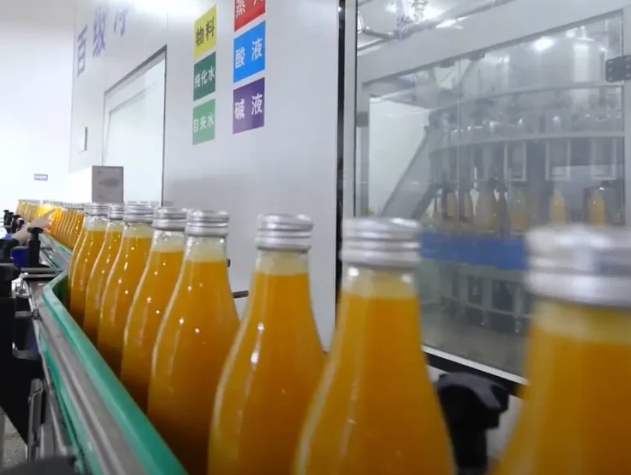
Selecting a manufacturing partner impacts not only R&D efficiency but also long-term product quality, supply chain resilience, and brand reputation. Overseas buyers should evaluate suppliers beyond unit prices across the following criteria:
Verify Processing & Category Capabilities
Confirm whether the factory specializes in your required product form—such as sea buckthorn puree, clear juice, fruit powder, seed/berry oil, capsules, or oral liquids. Clarify special processing needs upfront.
Inspect Raw Material Specs & Quality Assurance
Ask for documentation relating to sources of raw materials, processing methods, batching procedures, quality control measures, and COA forms. Make sure that their documentation meets the importing requirements of your target market.
Understand MOQ & Quotation Structure
MOQs vary based on product format, processing techniques, packaging types, and customization depth. When requesting a quote, provide your target product specs, estimated order volumes, packaging preferences, and destination market to receive an accurate breakdown.
Ensure Compliance with Packaging & Export Standards
For international markets, packaging must comply with local food contact material regulations, labeling laws (ingredients, allergens, shelf-life, language requirements), and logistics standards.
Assess Communication, Sampling, and Delivery Reliability
Evaluate the supplier’s responsiveness, sampling workflow, batch lead times, quality dispute resolution processes, and post-sale support before placing commercial orders. Clear communication and transparency are far more valuable than the lowest initial bid.
Youhero: Your Trusted Partner for Sea Buckthorn Food OEM/ODM Manufacturing
With over 30 years of industry experience, Youhero provides premium sea buckthorn raw materials alongside comprehensive OEM/ODM manufacturing services to global food brands, importers, wholesalers, and distributors.
Full-Spectrum OEM Production & Packaging Customization
We have a wide range of products such as puree, juice concentrates, powders, and oils. Youhero manufactures beverages, capsules, tablets, and oral pastes on a contract basis. For those who have existing formula, we guarantee smooth implementation of the process in accordance with quality requirements.
We also offer customized packaging options—including bottles, sachets, pouches, and boxes—complete with private label branding.
Professional ODM Product R&D
For brands entering the market without a ready formula, Youhero’s R&D team offers end-to-end ODM support. We help you develop market-aligned product concepts, optimize flavor and acidity, conduct stability tests, and design compliant packaging tailored to your target audience.
Stringent Quality Control & Full Traceability
Youhero enforces strict quality controls across every stage—from raw material inspection and in-line process monitoring to finished-product testing and lot-level traceability. We provide complete documentation support for international export and regulatory compliance.
Partner with Youhero Today
If you are looking for a trusted sea buckthorn supplier or contract manufacturer for juices, purees, powders, supplements, or teas, contact Youhero today.
Share your target product specs, packaging requirements, and estimated order volumes, and our team will tailor an optimal manufacturing solution for your brand.
Conclusion
Choosing between OEM and ODM is a strategic decision that depends on your brand’s development stage, internal capabilities, and market expansion goals. Clear communication regarding product requirements, quality standards, packaging, and target markets will ensure a successful, long-term supply chain partnership.


