
Why Does Sea Buckthorn Juice Separate? Causes and Solutions for Beverage Manufacturers
One week after bottling, that bright orange sea buckthorn juice may no longer be homogeneous: sediment will settle, a clear band will appear in the middle of the layer and oil will collect as a ring on the surface. It’s easy to think that means it’s spoiled, but typically that’s not true. Sea buckthorn juice is a natural mix of water, fiber and fruit oil and these fractions will separate by themselves. We will cover six reasons for the problem, simple checks to diagnose the issue and things you can do in production to fix it. Learn why it separates. Now your juice can be stabilized, a solvable technical problem.
Quick answer: Separation happens for three reasons: too big particles, oil not emulsified, and low viscosity – all made worse by pectin enzymes, high acidity and rough storage. Fix process first (homogenization, control enzyme), then fix formula (stabilizers or emulsifiers). Then prove it (accelerated stability tests).
What Does Sea Buckthorn Juice Separation Look Like?
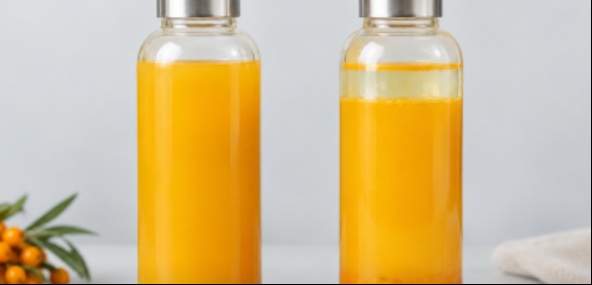
There are three forms of separation, and they often overlap. The classic pattern, as described in a 2022 technical review, is an oily layer on the surface and sedimented particles at the bottom.
| What you see | Technical name | Usual cause |
| Dense layer at the bottom | Sedimentation | Large or heavy pulp particles |
| Oily ring or film at the top | Creaming / oiling-off | Unemulsified fruit oil |
| Clear band under a cloudy top | Serum separation (syneresis) | Weak pectin network, low viscosity |
Is Separation Normal or a Quality Issue?
Some settling is to be expected with turbid juices without stabilizers. A “shake well” label is common. It’s not a safety issue in itself. Spoilage can be presented in various forms such as off-odors, gas, swelling or fermentation, all of which are signs of microbial growth, and need their own investigation.
Separation still has commercial significance. Buyers are shallow, judging by looks, and the same review notes that lipids that separate from the juice are prone to rapid oxidation, so poor stability can cost flavor and nutritional value as well.
Why Is Sea Buckthorn Juice So Prone to Separation?
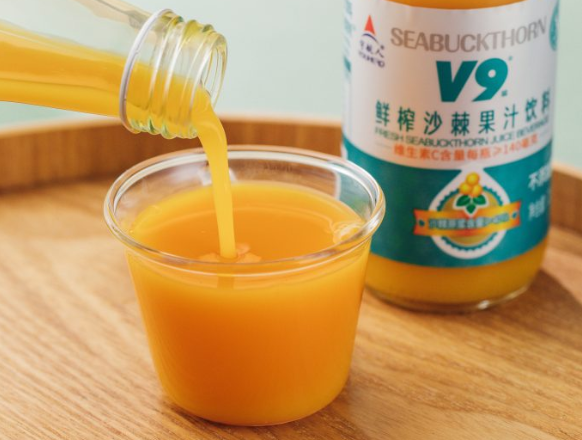
Picture a basic herb vinaigrette. You get water, oil, and bits that do not stay mixed. Over time the layers split again. Sea buckthorn juice can do the same thing. It has pulp bits, pectin, and fiber. It also contains pulp lipids with a lot of palmitoleic acid, which is omega-7. Why Does Sea Buckthorn Juice Separate? The review explains that these lipids separate from the juice and that pulp polysaccharides hold water poorly, which produces the watery layer. In short, the berry’s nutritional richness is exactly what makes stability harder.
Six Main Causes of Sea Buckthorn Juice Separation
1. Oversized or uneven particles. Under Stokes’ law, settling speed rises with the square of particle diameter. Halve the diameter and particles settle roughly four times slower. A wide size distribution means the biggest particles always drop first.
2. Unemulsified oil. In a study of sea buckthorn oil emulsions, higher oil content produced bigger droplets, and bigger droplets tended to cream in accelerated centrifugation.
3. Low viscosity. Thin juice can’t hold particles in place. Sugar-free recipes and diluted composite drinks are especially susceptible, since dissolved sugars and juice solids contribute body.
4. Pectin active enzymes. The main causes of cloud loss in fruit juices are pectin methylesterase (PME) and polygalacturonase (PG). In PME studies it was shown that demethylated pectin yields a distinct serum and sediment and the problem can be controlled by heat processing. Most of this evidence is from other fruits so verify the effect on your own sea buckthorn batches.
5 . High acidity. Sea buckthorn is quite acidic and this restricts the choice of stabilizers. For example, supplier data for high-acyl gellan gum recommend avoiding pH below 3 with prolonged heating, because of hydrolytic degradation.
6. Stress during processing and storage. Weak homogenization, trapped air, temperature swings and freeze thaw cycles all push the system toward separation and long shelf life gives gravity more time.
How to Find the Root Cause
Match the symptom to the test before changing the recipe.
| Test | What it tells you | Read the result |
| Static settling (clear bottles at 4 °C and 25 °C) | Type and speed of separation | Oil ring points to emulsification; sediment points to particles or viscosity |
| Accelerated centrifugation | Early prediction of creaming and settling | Fast phase split means a weak system |
| Particle size (D50 / D90) | Whether homogenization is sufficient | A large D90 explains sediment |
| Viscosity across shear rates | Body available to suspend particles | Thin, near-water flow is a red flag |
| Residual enzyme check | Risk of cloud loss | Clear serum with low viscosity suggests PME activity |
Laser particle size analysis is the standard way to quantify results, and was used in a 2024 sea buckthorn juice study of emulsifiers and microfluidization.
Proven Solutions to Prevent Separation
Begin with process.
- Homogenization. Small particles can stay in the mixture longer. The 2024 study mentioned earlier says homogenization may slow phase separation. It also notes that microfluidization, when used with emulsifiers, lowered particle size and helped the emulsion stay stable. A peer-reviewed study on sea buckthorn puree reported that high-pressure homogenization reduced particle size. It also said vitamin C and total carotenoids were not affected.
- Enzyme regulation. Apply a time-temperature step that corresponds with residual PME. Avoid overheating that dulls fresh flavor.
- Oxygen control. Deaeration and inert gas protect lipids prone to oxidation.
Then change the formula
- Stabilizers. Low-acyl gellan gum is a popular stabilizer for pulp suspension, with supplier guidance of 0.02–0.05%. Allowed in US under 21 CFR 172.665 but test it in your own acidic matrix.
- Emulsifying agents. In the above oil-emulsion study, much smaller droplets were formed with sodium caseinate and sugar ester than with soy protein isolate. Another study in 2022 found that sea buckthorn emulsions combined with a soy phospholipid blend had 99.5% colloidal stability. Results are from emulsions, so validate in a finished juice drink. Validate additive rules in each target market.
The clean-label route
If you want no added stabilizers, rely on stronger homogenization, a suitable pulp and fiber level, a shorter shelf life and a clear “shake before drinking” statement.
Packaging and logistics
Avoid freeze-thaw exposure, limit temperature swings in transport, and run stability trials under real distribution conditions.
How Youhero Builds Stability into Sea Buckthorn Juice
Stability starts before the homogenizer. With over 30 years in sea buckthorn, we control the variables that make formulation harder:
Consistent raw material. Our juices come from certified-organic wild sea buckthorn bases of about 550,000 mu on the Inner Mongolia Plateau, so your formula starts from a predictable input.
Oxidation control. We apply nitrogen protection from fast thawing through pulping, which helps preserve vitamins and natural flavor. That matters because the fruit’s lipids oxidize quickly.
Batch verification. Every batch passes 15+ tests, including heavy metals, nutrient content and microbial counts, backed by traceability from raw material to processing date.
Formulation support. Our R&D team, backed by the National Seabuckthorn Engineering Research Center, can adjust sugar level, flavor and nutrient concentration for your market. Qualified partners can request free samples to run their own stability trials.
Planning a new sea buckthorn drink? Request a sample or talk to our technical team. You can also explore our sea buckthorn juice range.