
Sea Buckthorn and Cholesterol: Can It Help Support Healthy Cholesterol Levels?
Sea buckthorn has long been used in traditional medicine, while more recent research is exploring its possible role in cardiovascular health – specifically cholesterol management. Numerous clinical trials suggest it could potentially help support healthier lipid levels in those already with elevated levels. Here’s a breakdown of what the evidence really says, why sea buckthorn may work in that direction, and what to consider before adding it into day-to-day routine.
What Is Sea Buckthorn?
Sea Buckthorn (Hippophae Rhamnoides) is a tough plant that has bright orange berries. It’s been in use for a long time in traditional Chinese remedies, Russian practices and also Nordic remedies. In general, berry oil is usually more concentrated in palmitoleic acid (that is the omega-7 form) and the oil from seeds contains an increased amount of omega-3, omega-6 and omega-9 fatty acids. This distinction is crucial when considering cholesterol-related claims as different studies have tested various extracts, but not the exact same extract every time.
Understanding Cholesterol: LDL, HDL, and Why the Balance Matters
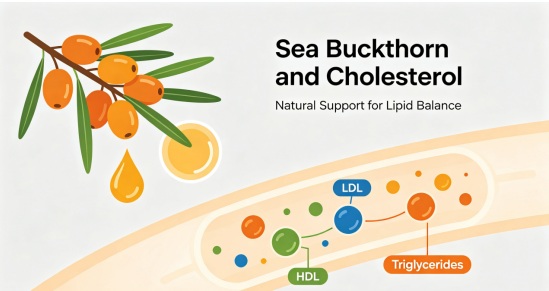
Cholesterol doesn’t have to be “bad” — the body requires it to produce hormones and for cell function. The key is what balance is maintained between LDL (often referred to as “bad” cholesterol, which may contribute to the formation of arterial plaque) and HDL (“good” cholesterol which assists in eliminating excess cholesterol out of in the bloodstream). Triglycerides are a different type of blood fat are also a part of a complete panel of lipids. The term “healthy cholesterol level” generally refers to maintaining LDL and triglycerides within the acceptable range while ensuring sufficient HDL and HDL levels, not simply dropping one number on its own.
How Sea Buckthorn May Support Cholesterol Health
Rich in Omega-7 (Palmitoleic Acid)
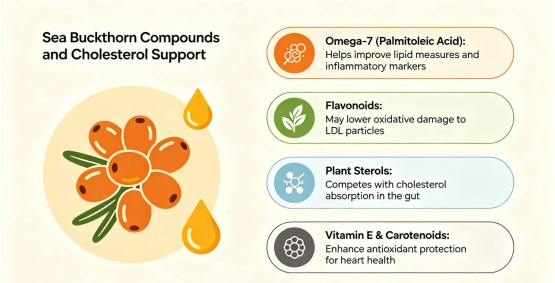
Sea buckthorn is one of the few plant sources naturally high in omega-7 fatty acids. Research on isolated palmitoleic acid has linked it to improvements in inflammatory markers and lipid measures in adults with dyslipidemia, though sea buckthorn oil itself contains a broader mix of compounds that may act together.
Sea buckthorn is, in a way, quite standout in terms of Omega-7 (palmitoleic acid). It’s one of the rare plant sources that’s naturally rich in omega-7. Some research focused on isolated palmitoleic acid suggests possible benefits for inflammation signals and blood lipid measures in adults who have dyslipidemia. Still, sea buckthorn oil isn’t just palmitoleic acid— it also includes a mix of other compounds, and they might work together in a kind of synergistic way.
Flavonoids and Antioxidant Activity
Sea buckthorn berries are pretty full of flavonoids and carotenoids, these compounds get studied a lot for how they might help lower oxidative damage to LDL particles. Oxidized LDL gets seen as more directly tied to the buildup of arterial plaque than LDL alone, and that’s why antioxidant content is often brought up next to cholesterol research too.
Plant Sterols (Beta-Sitosterol)
Certain sea buckthorn extracts have beta-sitosterol. It is a plant sterol that has been studied for its capacity to compete with cholesterol from food for absorption by the gut, possibly less cholesterol entering the bloodstream.
Vitamin E and Overall Lipid Profile Support
Sea buckthorn oil is also rich in vitamin E as well as carotenoids. Carotenoids are substances that researchers have found to improve antioxidant levels in trials of supplementation as a third factor that can help improve general cardiovascular health, in addition to cholesterol-specific benefits.
What Does the Research Say?
The evidence is more extensive than for most traditional botanicals, however it is still accompanied by important cautions. For example, a systematic review and meta analysis that pulled together 11 randomized controlled trials found that sea buckthorn supplementation lined up with lower total cholesterol and LDL cholesterol, plus an increase in HDL cholesterol, across the pooled groups.
There’s also a separate randomized, double blind, placebo controlled trial. In that study, sea buckthorn seed oil was given to both healthy adults and to adults with hypertension plus elevated cholesterol. After 30 days, the elevated cholesterol group had meaningful drops in total cholesterol, oxidized LDL, and triglycerides. Meanwhile, the healthy participants seemed to show little, or no change in their lipid markers.
The pattern appears frequently throughout the research. The most noticeable benefits are seen in those who already have elevated levels of lipids, and not so for those who have normal levels. Some individual studies have also found no significant effect on blood lipids at all, and sample sizes across many trials remain relatively small. Taken together, the evidence is promising but not yet conclusive enough to call sea buckthorn a proven cholesterol treatment — it’s better understood as an area of active, ongoing research.
Sea Buckthorn vs. Other Natural Options for Cholesterol Support
| Option | Primary active compound | How it works | Evidence strength |
| Sea buckthorn | omega-7, flavonoids, beta-sitosterol | antioxidant behavior, supports lipid metabolism, and it may compete with sterol absorption | Moderate — several RCTs, and it seems most convincing in people who already have elevated lipids |
| Fish oil (omega 3) | EPA/DHA | typically brings down triglycerides, and LDL usually drops a bit | Strong — lots of research behind it |
| Oat fiber (beta glucan) | soluble fiber | it helps grab bile acids, then reduces cholesterol absorption in the gut | Strong — very well confirmed |
| Plant sterol supplements | sterols and stanols | they basically crowd cholesterol out during absorption | Strong — the LDL-lowering story is pretty solid |
Overall, sea buckthorn holds up pretty well compared with other investigated natural options, even if oat fiber and separate plant sterol supplements still have the longer, more consistent record for LDL lowering, so the data feel a bit more settled there.
How to Incorporate Sea Buckthorn Into Your Routine
Sea buckthorn can be purchased as the oil of a berry, seed oil juice, or as supplementation with encapsulation. If supporting cholesterol is your purpose, be sure to check if a product contains seeds oil, oil from berries or a mix, as the sterol and fatty acids amount differs between. Just follow the dosing directions on the label, or ask a healthcare provider, or a registered dietitian for advice that fits your own health profile , since this piece isn’t meant to replace personalized medical guidance.
Who Should Be Cautious About Taking Sea Buckthorn?
Sea buckthorn could interfere with blood thinners and its effects in the course of pregnancy or during breastfeeding haven’t been studied thoroughly, therefore, caution is advised in these instances. Patients who have been suffering from high cholesterol levels or heart disease shouldn’t use sea buckthorn to substitute of prescribed treatments It should serve as a supplement and only after consulting with an expert.
Sea Buckthorn as Part of a Broader Cholesterol-Healthy Lifestyle
No single food or supplement works in isolation. The research on sea buckthorn is pretty relevant, but not in place of the basics for cholesterol management, like a diet that’s high in fiber and unsaturated fats, keeping saturated and trans fat intake limited, plus getting regular physical activity. Also, routine lipid panel checkups with a healthcare provider really matter, because without that oversight, things can get murky.
Sea buckthorn is a real evidence-based, scientifically proven potential to support better cholesterol levels, particularly for those who have high lipid level due to the flavonoids, omega-7 and sterols in plants. The evidence at present isn’t sufficient to consider it a stand-alone treatment, and it’s best used as a part of an overall, medically-guided treatment for cardiovascular health.
If you’re sourcing extracts of sea buckthorn, oil or raw materials to make a supplement or health product, you’ll find more details on the available formulations and specifications on Youhero.
This article is meant for informational only and is not intended to replace medical advice from a professional. If you are concerned regarding your cholesterol levels talk to a doctor or registered dietitian prior to starting any new supplements.