
Sea Buckthorn in Functional Beverages: Why Is This Superfruit Gaining Attention?
Walk any wellness aisle and you’ll see a bright orange new arrival. Sea buckthorn in beverages has evolved from a regional tradition to a serious topic for brand owners. It’s a practical appeal: a naturally tart flavour, a vivid colour, and a nutrient profile that corresponds to what shoppers expect from a functional beverage. Below, we break down what the numbers say about this trend. We also look at the drink types that tend to sell well. Next come the common recipe mistakes to watch for. After that, we explain what to check when picking a production partner. Overall, sea buckthorn is growing because the flavor fits, the product story makes sense, and customer interest is rising.
Why Is Sea Buckthorn Gaining Attention in the Beverage Market?
A growing niche within a large category
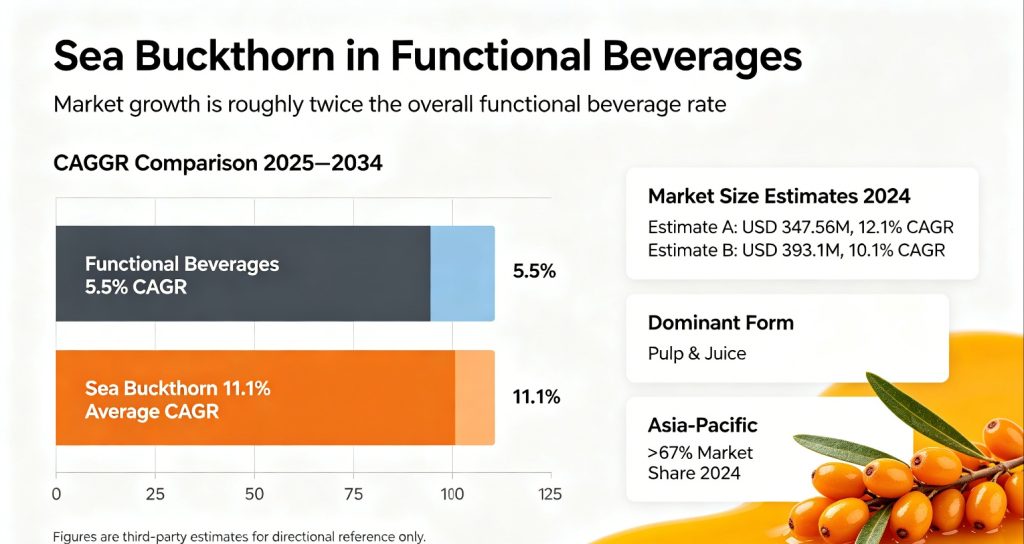
The wider category is large. The global functional beverages market was valued at USD 151.7 billion in 2025 and is predicted to expand at a 5.5% CAGR with 2034. Sea buckthorn is a much smaller yet faster-growing piece. Price quotes differ by research company: one report values the sea buckthorn market at USD 347.56 million in 2024 with a 12.1% CAGR, while one more puts it at USD 393.1 million in 2024, growing at 10.1% a year through 2034. Deal with these as directional instead of precise. The pattern corresponds, though: sea buckthorn is expanding at approximately twice the rate of the total group.
And form matters. By form, pulp and juice is expected to maintain the largest share, driven by strong adoption in food and beverage, and Asia-Pacific held over 67% of the market in 2024. Thus, the category is already monetised in beverages.
Buyers desire greater than hydration
Consumers increasingly reach for drinks with a job to do. Analysts note a change towards hydration for sports performance, gut-microbiome support, and anxiety alleviation. A sharp, vitamin-rich, plant-based berry fits neatly into that story. Market researchers likewise now checklist super-fruit essences as a distinctive ingredient kind within practical drinks, an indicator that the “superfruit” tag has actually come to be a genuine formulation group.
Clean label and premium positioning
Sea buckthorn also suits premium, transparent product stories. One industry report estimates that shoppers will pay 25–40% more for organic variants, though this is a commercial market estimate and should be validated for your target region.
The Nutrients Behind the Functional Appeal
Sea buckthorn’s reputation rests on its composition. Here is what the literature reports:
| Component | What research reports | Beverage angle |
| Vitamin C | About 400 mg/100 g in the berries studied | Immune-support positioning |
| Flavonoids | Quercetin, kaempferol, myricetin, isorhamnetin | Antioxidant story |
| Carotenoids | Mainly β-carotene, lycopene, lutein, zeaxanthin | Natural orange color |
| Organic acids | Malic, quinic, oxalic, citric, tartaric | Sharp, refreshing tartness |
Do not trust paper figures, but always ask for a certificate of analysis. Values vary with variety, origin and time of harvest. And also make sure claims are compliant. Only if permitted by your market, use words such as “rich in vitamin C”. EU health claims are regulated to ensure that they are scientifically substantiated and not misleading.
Popular Types of Sea Buckthorn Beverages
Sea buckthorn is currently used across foods; one review notes that products such as cheese, yoghurt, and drinks currently take advantage of its application. In drinks, the most common formats are:
- Ready-to-drink juice and blends. Pairing with apple, pear, or orange softens the tartness. See our sea buckthorn juice.
- Functional shots. Concentrated, small-serve formats suit “daily wellness” positioning. One of our health-food customers built a shot line on organic-certified juice.
- Tea and tea-based drinks. Fruit-tea blends give a natural way to add color and acidity. Explore sea buckthorn tea.
- Smoothies and sparkling drinks. Pulp adds body and a golden hue.
- Concentrates and pure pulp. Ideal for co-packers and R&D teams. See pure pulp.
Formulation Challenges (and Practical Fixes)
1. Getting the right tart taste
The acids in sea buckthorn give it a bright, sharp flavor. That sharpness can feel too strong. Add sweeter juices, or try a small amount of natural sweetener if you are aiming for less sugar. You should also test at different dilution levels with the people you plan to sell to.
2. Dealing with sediment and feel
Raw juice comes with many solids. It has suspended particles and it also brings a lot of vitamin C. Decide early if you want a cloudy drink with pulp, or if you want it clearer. Then pick either homogenization steps or a stabilizer system that fits your goal.
3. Protecting vitamin C
This is the big one. Research on industrial processing found that juice production caused a 5–11% loss of total ascorbic acid, concentrate production caused about 50% depletion, and even 7 days of storage at 6 °C cut it by roughly 11–12%. In a separate study on beverages it was seen that ascorbic acid was the main compound that was still decreasing after the first days of storage. Practical solutions include mild heat treatment, aseptic filling, a cold chain and label claims based on end-of-shelf-life testing.
How to Choose a Sea Buckthorn Supplier
Use this list:.
- Certifications: ISO 22000, HACCP, FDA registration, organic certifications
- Supply security: own plantations and cold storage, not just trading
- Capacity: proven lines that can scale with your order
- R&D support: help with sugar reduction, flavor balancing, and stability
- Flexibility: OEM/ODM options and reasonable minimums
At Youhero, we have actually collaborated with sea buckthorn for over three decades. Our company reports a 550,000-mu basic material base, 10,000 lots of − 18 ° C cold store, and juice lines generating 300,000 containers each day. We hold ISO 22000, HACCP, FDA registration, USDA Organic, and EU Organic qualifications. We offer totally free samples, and our OEM minimum is 500 units. Discover more regarding our certifications and OEM/ODM personalization.
Frequently Asked Questions
So why is sea buckthorn featuring in new drink launches? Mainly because it hits three things at once, a flavour that people remember, a nutrient story that has real research behind it, and a fit with a functional beverage market that continues to grow.
But it’s the details that make a product work. You have to cut that tartness, hold vitamin C against processing and storage, and you need a vendor who can stand behind their quality with paperwork, not just promises. If you are working on a sea buckthorn drink we can send you free sample or have a chat with our R&D team and we will help you test it out.