
Sea Buckthorn Oil Grades Explained: CO2 Extract vs Cold-Pressed vs Supercritical
A brand that sells supplements sourced from food grade sea buckthorn oil offers three supplier listings: one listing says “cold-pressed,” another “CO2 extracted,” and another “supercritical” — with prices that vary between two and three times. Which one is more effective and does the gap represent real quality issues or is it just a matter of terminology? We will then break down the meaning of these terms and how they impact the retention of nutrients, as well as the best way to judge a company’s claims prior to committing to placing a bulk purchase.
What Does “Food Grade” Actually Mean for Sea Buckthorn Oil?
Food grade sea buckthorn oil refers to oil that meets food safety standards — controlled levels of heavy metals, pesticide residues, and microbial contaminants, verified through testing and certification. This is a safety baseline, not a description of extraction method. A common confusion among buyers is assuming “food grade” tells you something about purity or nutrient content — it doesn’t. Two oils can both be legitimately food grade while differing significantly in how much of the plant’s active compounds actually made it into the final product, which is where extraction method comes in.
The Three Main Extraction Methods for Sea Buckthorn Oil
Cold-Pressed Extraction
Cold pressing mechanically presses seeds or berries to release oil without added heat or chemicals. It’s simpler and cheaper to produce, but the process has a well-documented limitation: cold pressing generally results in lower oil yield compared to solvent-based or supercritical methods, and exposure to oxygen and friction heat during pressing can degrade some of the more delicate bioactive compounds.
Solvent Extraction
Solvent extraction, usually made with hexane and similar chemical solvents, yields high yields at low costs however, it poses a solvent risk unless it is thoroughly refined. For food grade sea buckthorn oil destined to be used in skincare or supplement formulations, this technique typically has less market trust than CO2 alternatives or those cold-pressing.
Supercritical CO2 Extraction
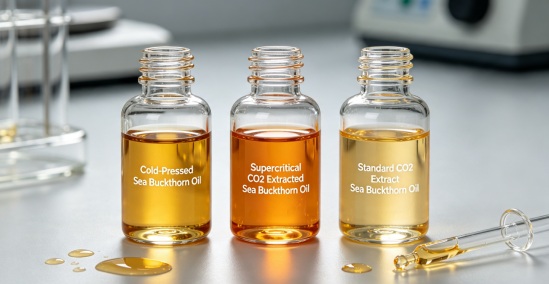
Supercritical CO2 extraction employs carbon dioxide at a controlled pressure and temperature, usually below 40 °C, to create a solvent that doesn’t leave residual after processing. Studies comparing extraction methods revealed that supercritical CO2 extraction yielded greater phytosterol total and individual levels in sea buckthorn oil when compared with cold pressing and hexane extraction, which makes it the method most often associated with higher nutrition retention, as shown in published studies.
How Extraction Method Affects Nutrient Retention and Purity
The gap between methods isn’t marketing exaggeration — it shows up in lab data. CO2 extracts can contain three to ten times more carotenoids than cold-pressed sea buckthorn oil from the same berry source, and the low-temperature process also better preserves gamma-tocopherol, a form of vitamin E particularly effective against oxidative damage that heat-intensive processing tends to degrade. Because supercritical CO2 fully evaporates after extraction, the resulting oil also avoids the solvent-residue concern associated with hexane-based methods, while still achieving meaningfully higher yields than simple cold pressing.
Cost vs Quality: Why Supercritical CO2 Oil Costs More
Supercritical CO2 equipment requires precise pressure and temperature control — published extraction studies typically operate in the 27–45 MPa pressure range at carefully maintained low temperatures — representing significant capital investment and energy cost compared to a mechanical press. That cost difference isn’t arbitrary markup; it reflects genuinely higher yields of preserved bioactive compounds, tighter batch consistency, and elimination of solvent-residue risk. For brands formulating products where potency and consistency matter — cardiovascular support, immune formulations, premium skincare — this cost premium is generally justified by measurable differences in the finished oil’s composition.
Seed Oil vs Pulp Oil: Does Extraction Method Matter Differently?
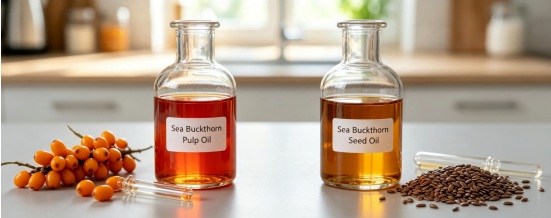
Sea buckthorn seed oil and pulp (berry) oil have naturally different compositions — seed oil is richer in linoleic and linolenic acid, while pulp oil concentrates more carotenoids and palmitoleic acid (Omega-7). Extraction method interacts with both, but the practical impact varies: since seed oil’s primary value lies in its fatty acid ratio, a well-executed cold press can still deliver a reasonably strong product, while pulp oil’s carotenoid-dependent value is where supercritical CO2’s advantage becomes most pronounced.
How to Evaluate a Sea Buckthorn Oil Supplier’s Extraction Quality
Before you finalize a supplier, make sure you have an analysis certificate (COA) that confirms the actual amount of nutrients in the product, rather than simply taking extraction claims as a given value. Confirm the stated extraction method matches third-party testing results, check for relevant organic or food safety certifications, and ask about batch-to-batch consistency data — a supplier confident in their process should have no hesitation sharing this documentation upfront.
FAQ
Extraction method isn’t a marketing detail — it’s a measurable driver of how much of sea buckthorn’s nutritional value actually reaches your finished product. Youhero produces food grade sea buckthorn oil using supercritical CO2 low-temperature extraction, backed by five international certifications and stable batch-to-batch supply for OEM and bulk partners — reach out to discuss your formulation’s specific requirements.