
What to Look for When Buying Sea Buckthorn Supplements
The market for sea buckthorn supplements has grown exponentially, and with it the confusion. Go to any health shop or browse Amazon and you’ll discover numerous sea buckthorn supplements that make big claims regarding Omega-7 and skin regeneration and support for the immune system. However, there are a few that offer. Certain extraction methods are poor which degrade active substances. Other companies mix in fillers that weaken the substance you’re actually paying for. We have cut through the noise with five distinct quality indicators, so that you can make a well-informed purchase, and not make an expensive error.
Why Sea Buckthorn? A Quick Look at What Makes It Valuable
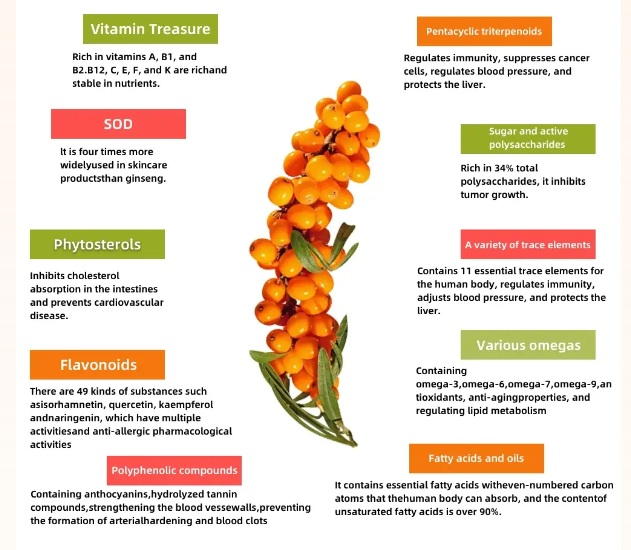
Before you even think about buying a product, it helps to sorta know what you are buying. Sea buckthorn (Hippophae rhamnoides) is one of the few plant based sources that naturally contains Omega-7 (palmitoleic acid), and yes this fatty acid is often linked with skin cell renewal, mucosal support, and cardiovascular function too. And unlike Omega-3 and Omega-6, which are everywhere in supplements, Omega-7 feels a bit more uncommon, so sea buckthorn has been getting real attention from researchers and nutrition specialists.
But it doesn’t stop there. The berry also brings carotenoids , those are the pigment compounds that create that strong orange color, plus vitamins A, C , and E. It also contains over 190 bioactive components. In a review that appeared in Molecules (2021), sea buckthorn berries showed antioxidant, anti-inflammatory, and liver-protective effects across a mix of clinical plus preclinical work, not just one type of study.
The catch is, though. This nutritional richness is fragile. Poor extraction, contaminated sourcing, or aggressive processing can strip out the very compounds that justify the price tag.
The 5 Pillars of Quality in Sea Buckthorn Supplements
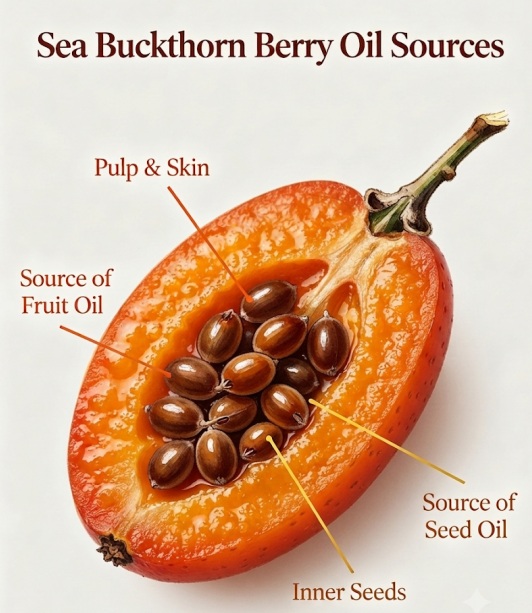
1. Extraction Source: Fruit Oil vs. Seed Oil vs. Whole Berry
This is the single most important distinction on any sea buckthorn label and most consumers just overlook it entirely.
The fruit oil (extracted from the skin and pulp) is the most important food source for Omega-7 and carotenoids. It is a deep red-orange hue and is the one that is most closely associated with the health benefits of mucosal and facial skin.
Seed oil comes from seeds within the berry. It is a rich source of Omega-3, 6, and 9 fatty acids, having the appearance of a lighter yellow and a therapeutic profile, which is more relevant for the anti-inflammatory and cardiovascular systems.
| Fruit Oil | Seed Oil | |
| Primary nutrient | Omega-7, Carotenoids | Omega-3, 6, 9 |
| Color | Deep orange-red | Light yellow |
| Best for | Skin, mucous membranes | Heart health, inflammation |
| Extraction difficulty | Higher | Lower |
A product labeled simply “sea buckthorn oil” without specifying the source could be either — or a poorly balanced blend of both. The gold standard is a whole-fruit product that specifies both fruit and seed oil content with clearly stated Omega-7 percentages.
2. Extraction Method: Why Supercritical CO2 Matters
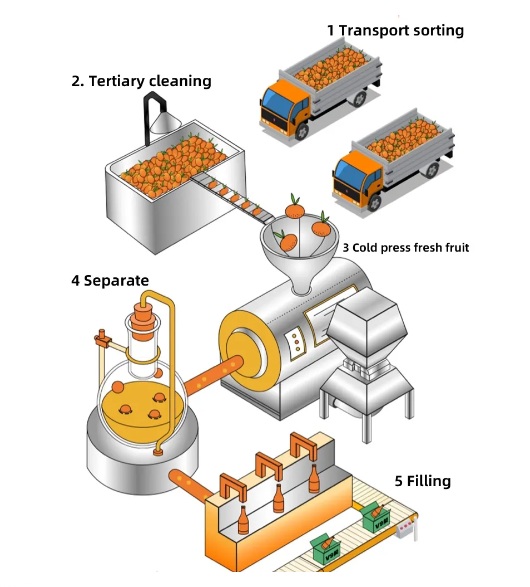
The extraction process determines the extent to which of the initial nutritional profile remains in the product.
Supercritical CO2 extraction is the industry standard for sea buckthorn oils of the highest quality. It makes use of carbon dioxide pressurized to act as a solvent at lower temperatures to preserve heat-sensitive substances such as carotenoids and tocopherols, with no leaving behind any chemical residues in the final product. It is a pure and concentrated oil with an entire bioactive profile.
Alternatives that are less expensive – for instance, the extraction of hexane solvent is faster and cost-effective for producers However, they may leave trace residues of solvent and reduce heat-sensitive nutrients during the process. If a product doesn’t state its extraction method, this lack of information is an indicator of danger.
3. Purity and Ingredients: Reading Between the Lines
Turn the bottle upside down and look over it’s “Other Ingredients” section carefully. The best sea buckthorn supplements will be simple and clear list of ingredients. What you’d like to see:
- Capsules made of vegetable cellulose(rather as gelatin which isn’t suitable for vegans or vegetarians)
- There are no artificial preservatives or colorings
- The smallest amount of fillers such like magnesium stearate, silicon dioxide – certain flow agents can be used in capsule manufacturing, however they shouldn’t dominate the list of ingredients
What you don’t want to read about is maltodextrin, soybean oil that is used as a carrier with no disclosure, or any other ingredient that you can’t identify by an easy search.
4. Sourcing and Organic Certification
Sea buckthorn mostly grows across Himalayan regions in China, Mongolia, Russia and also parts of Europe. When the plants are raised in unregulated surroundings, they can accumulate heavy metals, pesticide residues, and other environmental contaminants — and yes, those may get carried into the final oil, sometimes in a more concentrated way than you’d expect.
Look for:
- Certified Organic designation from a recognized body (USDA Organic, EU Organic, or equivalent)
- Transparent origin labeling — the region or country of harvest should be stated, not hidden behind vague supply chain language
- Sustainable harvesting practices — sea buckthorn plants have a natural harvest cycle, and over-harvesting damages the berry and reduces the Omega-7 content in the extracted oil

5. Third-Party Testing and Certifications
No reputable supplement brand should ask you to take their quality claims on faith.Third-party testing conducted by an accredited laboratory a process that distinguishes genuine products from the ones that are driven by marketing.
What to look out for:
- Certificate of Analysis (CoA)- a document indicating the level of the key minerals, nutrients and microbiological contaminants that are available for each production batch.
- GMP Certificate (Good Manufacturing Practice)– This certification ensures that the manufacturing facility is in compliance with the standards for quality control in production.
- NSF and USP certification-Additional third-party confirmation that the product is what it says on the label
If a company isn’t willing to share its CoA or is unable to verify GMP status, it’s time to move on.
Common Mistakes to Avoid
Even experienced supplement buyers fall into these traps:
Vague labeling. “Sea buckthorn extract” tells you almost nothing. A quality product states the part of the plant used, the Omega-7 content as a percentage, and the extraction method. Anything less is a label designed to obscure rather than inform.
Price too good to be true. Genuine supercritical CO2 extraction from organically certified sea buckthorn is a premium manufacturing process. A bottle priced significantly below market average almost certainly reflects a cheaper production shortcut somewhere in the chain — usually in extraction method or raw material quality.
No batch number or expiration date. These are basic traceability features. Their absence suggests inadequate quality control and makes it impossible to verify the CoA for the specific product you’re holding.
Matching the Right Product to Health Goal
Not all sea buckthorn supplements do the same job, so it’s useful to match the product to the health goal you want. Here’s a quick, sort of practical reference:
For skin support and mucosal comfort (think dry eyes , vaginal dryness , and gut lining) aim for formulas with a higher fruit oil portion , and make sure the Omega-7 amount is stated clearly.
For cardiovascular help and anti inflammatory support you’ll want something with a more even seed oil balance—so you get Omega-3 and Omega-6 in there too, not only Omega-7.
For overall wellness and antioxidant backing choose a whole-berry or full-spectrum option, because a combination of fruit oil plus seed oil generally gives the broadest nutritional coverage.