
Sea Buckthorn for Menopause: Benefits, Safety, and How to Use It
If you’ve been poking around the natural health space lately, you’ve probably noticed that menopause wellness is having a real moment. More and more supplement brands and personal care lines are hunting for that one ingredient that’s both safe and backed by hard clinical evidence. And right now, sea buckthorn for menopause is popping up on a lot of R&D shortlists. It’s not just hype. There’s real science underneath that bright orange berry.
Let’s start with what actually happens during menopause, because that sets the stage for everything else. When a woman’s ovaries start winding down, estrogen doesn’t just dip. It crashes. And that hormonal freefall triggers a whole cascade of changes all over the body. We’re going to walk through the biology, the clinical trials, and the practical formulation angles, so you’ll see exactly why this Himalayan fruit is getting so much attention.

What Happens During Menopause?
Hormonal changes in menopause
Think of menopause as your body’s internal chemistry set going through a massive withdrawal. Estrogen and progesterone production drops sharply as we age. Now, estrogen isn’t just about fertility. It also acts like a natural moisture retainer and a kind of vascular shield. When that shield disappears, tissues and organs start to lose water and become more fragile. It’s not a sudden switch, but the cumulative effect is profound.
Core symptoms women experience
From a product development standpoint, there are two broad categories of menopause symptoms that brands usually target. And they’re very different in nature.
Vasomotor symptoms – these are the ones that hit like a wave:
Hot flashes – that sudden rush of heat that floods your chest and face, often with a racing heart.
Night sweats – waking up drenched in the middle of the night, which wrecks your sleep cycle.
Mucosal atrophy and psychological shifts – these are quieter but equally disruptive:
Vaginal dryness – probably the most private and distressing symptom, often with stinging and inflammation.
Skin dryness – no matter how much moisturizer you slather on, it feels like your skin just won’t drink it in.
Reduced elasticity in skin and tissues – collagen loss speeds up, so facial skin and even intimate tissues lose that firmness.
Mood swings – anxiety, irritability, or low mood that seems to come out of nowhere.
Sleep problems – trouble falling asleep, frequent waking, and barely any deep sleep.
Does Sea Buckthorn Increase Estrogen?
This is the number one question we hear, both from consumers and from supplement buyers. And it’s a fair one. So let’s cut straight to the science: no, sea buckthorn does not boost systemic estrogen in the body.
In lab tests and animal studies, researchers have found that sea buckthorn doesn’t have phytoestrogen activity. It doesn’t mimic estrogen or bind to estrogen receptors the way soy isoflavones or black cohosh do. That’s a big deal. Why? Because a lot of women have conditions like breast nodules or uterine fibroids, or they’re in recovery from breast cancer. Their doctors often tell them to stay away from anything with hormonal or phytoestrogen effects.
Sea buckthorn gives them a hormone-free alternative that actually works. So if you’re formulating a product, you can absolutely position it as “safe for hormone-sensitive women” – that’s a strong differentiator.
How Sea Buckthorn May Help Menopause Symptoms
If sea buckthorn doesn’t contain estrogen, how on earth does it ease so many menopause complaints? Traditional herbalism has used it for centuries, and modern clinical research backs it up. The secret lies in its unusual fatty acid profile.
Supports Skin and Tissue Hydration
Sea buckthorn berry oil is one of the few plant sources rich in Omega-7 (palmitoleic acid). Omega-7 is a building block for cell membranes in your skin and mucous membranes – that’s the moist inner lining of your mouth, eyes, and vaginal area. When menopause dries you out from the inside, sea buckthorn doesn’t play with hormones. It goes straight to lipid replenishment. It delivers the raw materials your cells need to rebuild their barriers.
That translates into:
Skin dryness improvement – locking in moisture and repairing that weakened lipid barrier.
Mucous membrane hydration – easing dry mouth, dry eyes, and helping vaginal tissues regain their natural moisture and resilience.
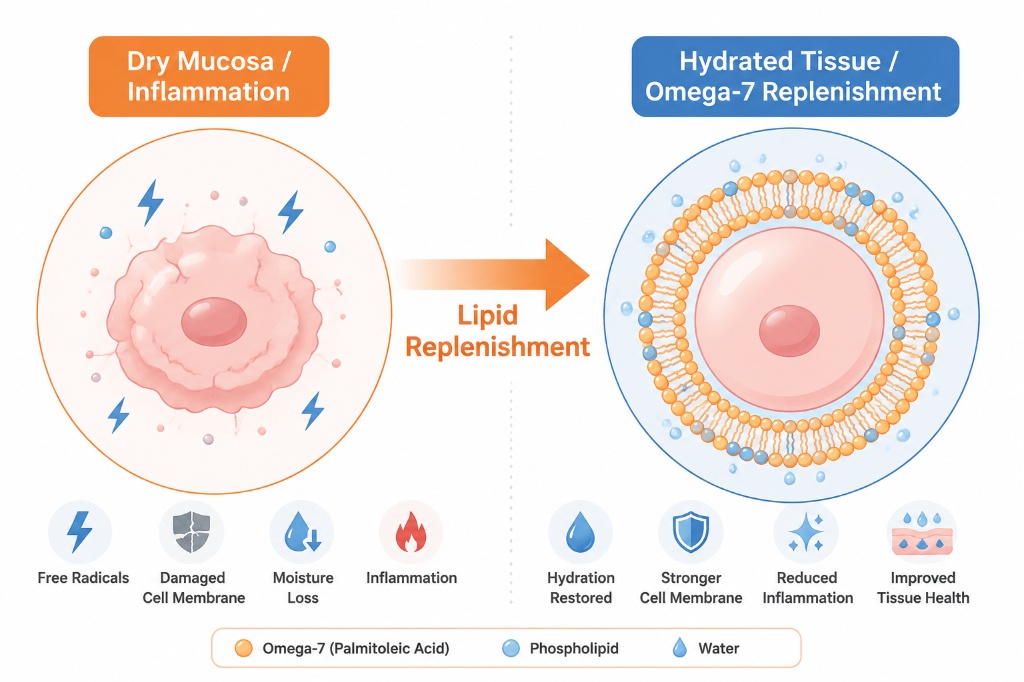
Helps Relieve Vaginal Dryness
Vaginal dryness…it’s the thing women are too embarrassed to talk about but it’s also one of the most urgent needs out there, let’s be honest. So to see if sea buckthorn might really help, researchers did a randomized, double-blind, placebo-controlled trial. And they published it in the journal Maturitis. The study included 116 post-menopausal women with severe vaginal dryness. After 3 months of daily intake of 3 grams of sea buckthorn oil, the results were clear: the epithelial integrity in the vaginal tissue was significantly improved. Dryness and burning sensations were remarkably reduced.
What’s more, the trial confirmed that the endometrium didn’t show any adverse changes. That’s powerful evidence that sea buckthorn oil for menopause can safely support natural lubrication without messing with your systemic estrogen levels. It’s a natural lubricating environment, no hormones required.
Anti-Inflammatory and Cellular Support
Underneath all that dryness, there’s often a low‑grade chronic inflammation going on. Sea buckthorn is loaded with superoxide dismutase (SOD) and a range of unsaturated fatty acids. Together, they help:
Reduce inflammation response – they act like a fire extinguisher for irritated mucosal tissues.
Support cell membrane repair – speeding up the turnover of epithelial cells so damaged tissue can heal faster.
May Support Hormone-Related Changes (Not a Hormone)
Sea buckthorn isn’t a hormone – we’ve covered that. But can it actually help with hot flashes, night sweats, mood swings, and that whole sleep mess? Turns out, yes.
Here’s how. It works as an adaptogen. When estrogen drops below a certain level, your hypothalamus – that’s your brain’s internal thermostat, by the way – gets confused. It overreacts to temperature changes.
Sea buckthorn doesn’t fix the estrogen, but it does something else. It supports your cardiovascular system, your endocrine system, and it helps blood vessels stay more flexible. It also calms your autonomic nervous system. All of that adds up to one thing: your body becomes less jumpy about temperature swings. So hot flashes happen less often. Night sweats don’t yank you out of deep sleep as much. And mood and sleep tend to follow suit.
As for mood swings, lower estrogen means less serotonin (your “happy hormone”) production in the brain. Sea buckthorn contains high concentrations of antioxidants that can reduce oxidative stress in brain tissues and act like natural nerve stabilizers protecting neurotransmitter pathways – helping you maintain balance without replacing serotonin but keeping communication clearer.
And what of sleep? Sea buckthorn helps your body access deeper, more restorative rest by decreasing night sweats and soothing your nervous system – leading to longer deep-sleep phases that make an enormous difference to overall restful rest.
Supports Skin Aging and Elasticity
Estrogen decline accelerates collagen loss – by several times compared to pre‑menopause. Sea buckthorn offers a rich supply of tocopherols (natural vitamin E) and carotenoids. These are potent antioxidants that hunt down free radicals, preventing skin cells from oxidizing and losing their bounce. It’s a solid skin elasticity support that works from the inside out.
How to Use Sea Buckthorn for Menopause
Now that we’ve covered the “why,” let’s talk about the “how.” There are some practical formulation and usage details you should know.
Sea Buckthorn Berry Oil vs. Seed Oil for Target Layouts
These two oils are not interchangeable.
Sea Buckthorn Berry Oil – it’s that vivid deep orange color, thanks to all the carotenoids. This is your Omega‑7 powerhouse. If your product is aimed at intimate care, mucosal dryness, or tissue repair, you want berry oil.
Sea Buckthorn Seed Oil – golden in color, no Omega‑7, but it has an excellent balance of Omega‑3 and Omega‑6. Go with seed oil if you’re targeting cardiovascular health, general anti‑inflammation, or brain support during menopause.
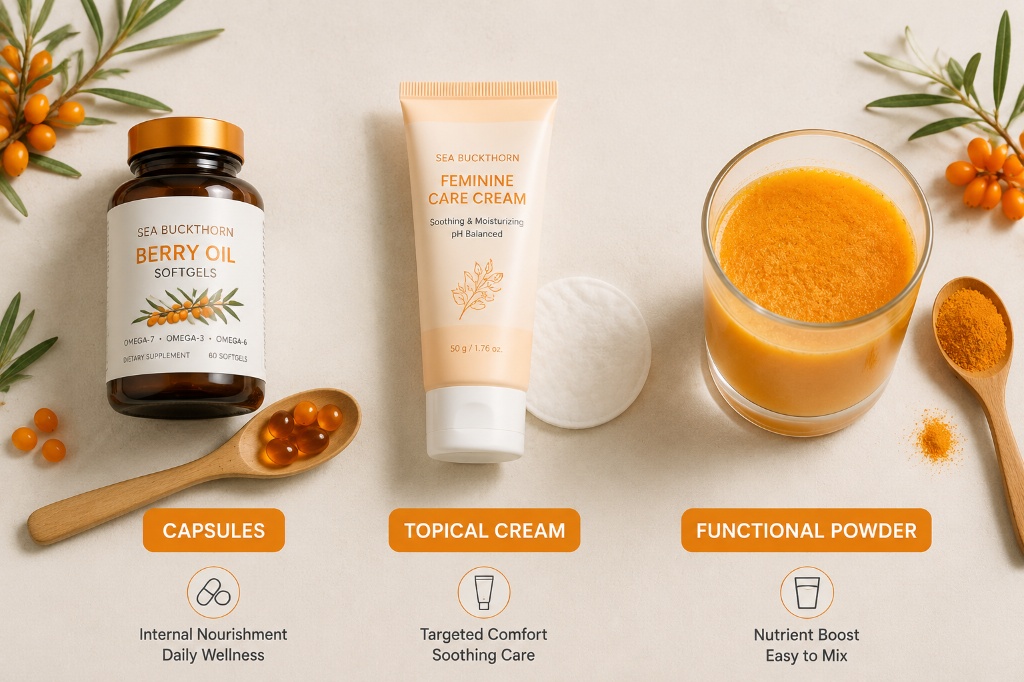
Application Forms: Capsules, Topical Creams, or Functional Powders
Capsules – straight berry oil in a softgel. This is the classic format in the U.S. and European markets for nutricosmetics and menopause supplements.
Topical creams and oils – you can blend a low percentage of berry oil into vaginal moisturizers or facial anti‑aging serums. Works well, but watch out for the orange tint.
Functional powders – using microencapsulation technology, you can turn the oil into a water‑soluble powder. That opens up possibilities for menopause drinks, meal replacements, or tablets.
Recommended Daily Use
Based on that clinical trial we mentioned, the effective dose to improve mucosal integrity and skin hydration is 2 to 3 grams of high quality pure sea buckthorn berry oil per day. That’s the sweet spot.
When To Take It (Morning/Evening)
You can take sea buckthorn oil with any meal, morning or evening. It’s fat‑soluble, so pairing it with some healthy fats – like nuts or avocado – helps your body absorb it better. A spoonful of nut butter or a few slices of avocado is really all you need.
How Long To See Results
From industry feedback and the clinical records, most menopausal women start noticing real changes in vaginal dryness, eye dryness, and rough skin after 2 to 4 weeks of consistent, full‑dose use. Give it a month, and you’ll likely feel the difference.
FAQ
Who Should Avoid Sea Buckthorn?
Sea buckthorn oil has a mild natural blood‑thinning effect, so it’s good for circulation. But if you’re on blood thinners like warfarin, or you’ve got surgery scheduled in the next two weeks, have a word with your doctor first. Same goes if you’re pregnant or nursing – always check with a healthcare professional before using.
Can I Take Sea Buckthorn Every Day?
Absolutely. It’s a natural berry extract, and at the recommended dose (under 3 grams daily), long‑term use is very safe. No dependency issues at all.
What Are The Negative Side Effects Of Sea Buckthorn Oil?
For oral use, serious side effects are practically unheard of. The only minor “side effect” comes from those high carotenoid levels. If you take way more than the recommended amount (and we mean a lot more), your skin might take on a temporary yellowish tinge. It fades as soon as you cut back. For topical use, pure berry oil is so deeply colored that if you apply it undiluted, it can temporarily stain your skin or light‑colored clothes. Just dilute it properly and you’ll be fine.