
Sea Buckthorn Oil Codex Standard: What It Means for Buyers
Two quotes for “sea buckthorn oil” can describe two very different products. One may be pressed from seeds, another taken from pulp, and neither quote has to say so. That gap is one reason Codex started work on sea buckthorn oil in 2026. But the work is still early: approved, not finished. This guide explains where things stand, what the standard could cover, and how you can check specifications, COAs and suppliers now, without waiting for the final text.
Where the Codex Work Stands Today
Codex is the food standards body of FAO/WHO. Its texts are not automatically law in any country but are rather international reference points for the protection of consumer health and the promotion of fair trade.
CCFO29 met in Kuala Lumpur on 9–13 February 2026 and sent the proposal on to the Commission. CAC49 met in Geneva on 6–10 July 2026 and agreed with the new work, which is listed on the Codex New Work Proposals page. One detail is easy to miss: the discussion paper put to CCFO29 suggested a standalone sea buckthorn oil standard, but the work that went forward is a revision of CXS 210, the same standard that covers other named vegetable oils.
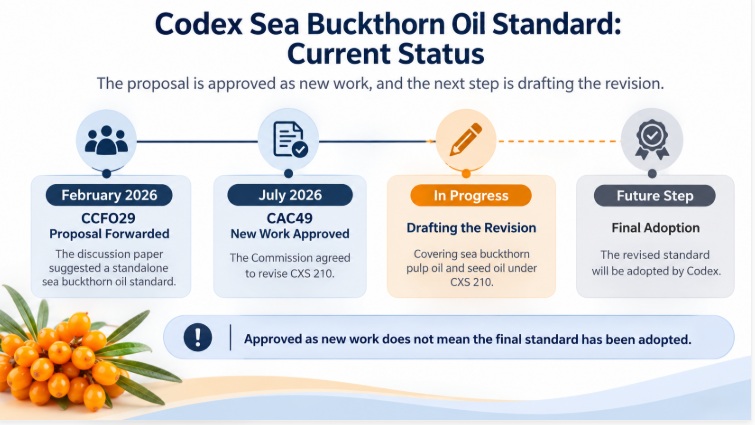
What Has and Hasn’t Been Approved
| Stage | What it means | Status |
| Approval of new work | The Commission agrees the work should start | Done (July 2026) |
| Drafting the revision | Proposed text for pulp oil and seed oil | Next step |
| Committee discussion | Members debate and refine provisions | Pending |
| Final adoption | The Commission adopts the revised standard | Not reached |
So if a supplier tells you their oil “meets the Codex sea buckthorn standard,” ask which text they mean. There isn’t one yet.
What the Standard May Cover, What Is Still Open
The scope was defined in the discussion paper as oil from Hippophae rhamnoides berries, from pulp and from seeds for human consumption. It suggested coverage of composition, quality criteria such as fatty acid profile, vitamin content and purity, and food safety. The authors also argued the oil is vulnerable to adulteration and informal trade.
“Those are proposals, not agreed provisions.” The limits, test methods and whether pulp oil and seed oil get separate requirements are to be determined. In the meantime, don’t take any number you see online as “the Codex limit.”
Why Buyers Should Care Before the Standard Is Final
Common definitions make quotes comparable. Today, “sea buckthorn oil” may mean seed oil, pulp oil or an oil from the whole berry. Once Codex defines pulp and seed oil, buyers who already name the plant part in their specifications will have less to rework.
Codex Is a Reference, Not Your Import Law
Your target market’s rules determine what you can sell. The EU is a good case in point. According to an industry summary of the EU Novel Food Catalogue, sea buckthorn berries, leaves and flowers are not novel foods, seeds and seed oil are not novel in food supplements, and other food uses may be considered novel. Check the current official entry before planning a product.
Use matters too. The Codex work concerns food. Sea buckthorn oil sold for cosmetics falls under different rules.
Seed Oil vs. Pulp Oil: Settle the Identity Question First
Both oils are derived from the same plant but are chemically different. Linoleic acid (33–36%) and α-linolenic acid (30–36%) were the main components of seed oil in a study of Canadian-grown cultivars, while palmitoleic acid (32–42%) was the main component of pulp oil . These figures vary with cultivar, origin, harvest and extraction, and they are research data, not Codex limits. They do show why the fatty acid profile is a useful identity check: a COA labeled “seed oil” whose profile looks like pulp oil deserves a question.
One open point: oil extracted from the whole berry, pulp and seeds together. Codex lists pulp oil and seed oil separately, so how a blend would be treated isn’t clear yet. Ask suppliers to state exactly what their oil is made from. For the basic differences between the two oils, see our guide to seed oil vs. pulp oil.
What to Check on a Spec Sheet and COA
None of the items below are confirmed Codex limits. They are checks buyers can use today.
| Check | Why it matters |
| Botanical name and plant part | Fixes identity: Hippophae rhamnoides, seed or pulp |
| Fatty acid profile | Confirms the oil matches the declared part and stays consistent between lots |
| Omega-7 content | Mainly relevant for pulp-type oils, depending on your application |
| Peroxide value and acid value | Indicators of oxidation and quality at the time of testing |
| Moisture and volatile matter | Can affect stability |
| Contaminants | Requirements depend on your destination market |
| Sensory characteristics | Color, odor and taste should match the agreed specification |
| Batch consistency | Look at several lots, not one result |
Agree the limits with your supplier and check them against your target market’s requirements. For general food-grade quality points, our article on choosing food-grade sea buckthorn oil goes further.
What is a COA worth?
“A COA is for one lot, not a promise of the next.” Check that the batch number matches with the goods you received, that the methods of testing are named, that the laboratory is identified (preferably independent) and that the parameters cover your intended use. Ask for test results on a number of lots to see how stable the product really is.
How to Audit a Seabuckthorn Oil Supplier
Start with asking for a dossier including: product specification, COA for each lot, third party lab reports, raw material origin and harvest information, extraction and processing method, lot coding and traceability records, supplier quality and food safety management documents.
Then ask a few direct questions. How are specification changes communicated? Are retained samples kept for each lot? Can they share data from multiple batches?
Treat these as red flags: a COA with no batch number, a “100% pure” claim that never names the plant part, or a fatty acid profile that doesn’t fit the declared part. For a wider view of sourcing, see our B2B buyer’s guide to sea buckthorn ingredients, and for extraction methods, our comparison of cold-pressed and CO₂-extracted oil.

What to Do Now
- Define the use and target market. Food, supplement and cosmetic requirements differ.
- Name the plant part in every specification. Seed oil, pulp oil, or a clearly described blend.
- Collect specification sheets and recent COAs from each supplier you use.
- Build a specification template you can update when the Codex text firms up.
- Track progress through Codex’s official pages and your national authority.
Talk to Youhero About Specifications and Documentation
Youhero’s sea buckthorn seed oil page shows seeds as the raw material, supercritical CO₂ extraction, and stated minimums per 100g of linoleic acid, linolenic acid and vitamin E, as well as its certifications. If seed oil is right for your project, ask for the specification sheet, a sample COA and the documentation your target market requires, and discuss formats and customisation options.